TL;DR: A pulled muscle or a knot that won’t let go can make you wonder if it will ever heal, and whether you’re helping or hurting it. Every muscle and fascia injury moves through the same three overlapping phases: inflammation, repair and remodeling, and the right care changes as you move through them. So the honest answer is that a mild strain often settles in a few weeks, a bigger tear can take months, and the tissue keeps remodeling for months after the pain is gone. Matching your care to your phase is what gets you back to your sport without re-injury.
What is a myofascial injury?
“Myofascial” means muscle plus fascia, the thin connective tissue that wraps every muscle fiber, every muscle and every muscle group. A myofascial injury is any damage or irritation to that system. It’s the most common kind of injury I see in athletes, from weekend golfers to former pros.
- Muscle strains: a “pulled muscle,” where fibers are overstretched or torn. Hamstrings, calves, groin, low back and neck muscles are common spots.
- Trigger points: small, tender knots in a muscle that can hurt where you press and also send pain somewhere else nearby. Repetitive motion, poor posture, an old injury or a long stretch of inactivity can set them off.
- Overuse injuries: irritation that builds from the same motion done again and again, like a tennis serve, a golf swing or miles of running, without enough recovery.
- Acute sports injuries: a sudden sprint, cut or awkward landing that overloads the tissue in one moment.
The 3 phases of healing
Your body heals soft tissue in three phases that overlap rather than switching off and on like a light. The time ranges below are approximate. Age, overall health, which tissue is hurt and how badly all change the clock. Muscle has a rich blood supply, so it tends to move through these phases faster than tendon or ligament.

Phase 1: Inflammatory (acute) phase, roughly the first few days to a week
What’s happening: Right after injury there’s bleeding in the tissue, then inflammation starts within hours and usually peaks around days 1 to 3. Inflammation isn’t the enemy. It clears out damaged cells and sends the signals that start repair. It then settles over the following week or two.
What it feels like: pain, swelling, tenderness, maybe bruising, and muscles that guard or spasm.
What care looks like:
- Protect it, briefly. Unload or limit the movements that hurt for about 1 to 3 days. Longer rest than that can actually leave the tissue weaker.
- Elevate and compress a swollen limb when you can.
- Get it looked at if it’s more than a minor tweak, so we know what’s injured and that nothing needs a physician.
- Go easy on ice and anti-inflammatories. Ice can take the edge off pain, but there’s little high-quality evidence that it speeds healing, and current sports medicine guidance suggests anti-inflammatory approaches may slow repair. Talk with your physician before stopping or starting any medication.
- In our office: a thorough exam first, then gentle care that respects the injury, such as kinesiotape for support and comfort, Class IV laser and gentle hands-on work around (not on) the most irritated area.
Phase 2: Repair (proliferative) phase, roughly day 2 to week 4 and tapering after

What’s happening: Starting within the first day or two, your body lays down new collagen and new blood vessels to patch the injury. This early patch is weak and laid down in a random pattern, a lot like a first coat of scar tissue.
What it feels like: sharp pain fades, but the area feels tight, stiff and easy to aggravate. This is the phase where most people either rush back too soon or stay too careful for too long.
What care looks like:
- Start loading, guided by pain. Gentle, pain-free movement and light strengthening tell the new tissue how to line up.
- Keep the rest of you moving. Pain-free aerobic exercise a few days after injury helps blood flow and keeps you fit.
- In our office: soft tissue work becomes a bigger part of the plan, such as instrument-assisted soft tissue mobilization (IASTM), manual therapy, trigger point work, muscle energy stretching and cupping, along with therapeutic exercise when it fits your plan and kinesiotape as needed.
Not sure which phase you’re in?
Book an exam with Dr. Bryan. We’ll find out what’s injured, check for anything that needs a physician, and build a plan for where you are right now, not where a generic handout says you should be.
Phase 3: Remodeling (maturation) phase, roughly week 2 or 3 to a year or more
What’s happening: The patch matures. Collagen fibers reorganize and line up along the lines of stress you put through them, and the tissue slowly gets stronger. This phase overlaps with repair and keeps going for months, often a year or more, long after the pain is gone.
What it feels like: you may feel “fine” day to day, but the area tires sooner, feels tight after hard efforts or flares up when you push. Feeling fine is not the same as being fully healed, and this is when many re-injuries happen.
What care looks like:
- Progressive strength and sport-specific work. Heavier loading, speed and the movements your sport demands, built up step by step.
- Restore full range of motion so the remodeled tissue isn’t short and stiff.
- A planned return to activity, based on strength and function, not just the calendar.
- In our office: IASTM and manual therapy for lingering stiffness, therapeutic exercise when it fits your plan, and for stubborn, long-standing problem spots, PiezoWave focused shockwave may be part of the conversation.
The phase 1 to 2 trap
Most people start feeling better as phase 1 settles, then go right back to the activity that caused the injury. The new tissue is still weak and disorganized, so it gets overloaded again before it’s ready. Repeat that cycle and a short strain can turn into a nagging, recurring problem, and repeated overload over time can contribute to tendon problems like tendinopathy.
Why it matters
A hamstring that feels fine after two weeks may still be early in remodeling. Go straight back to all-out sprints and the weak spot is the first thing to give. Matching what you do to the phase you’re in is what keeps a three-week setback from turning into a three-month one.
The bigger picture
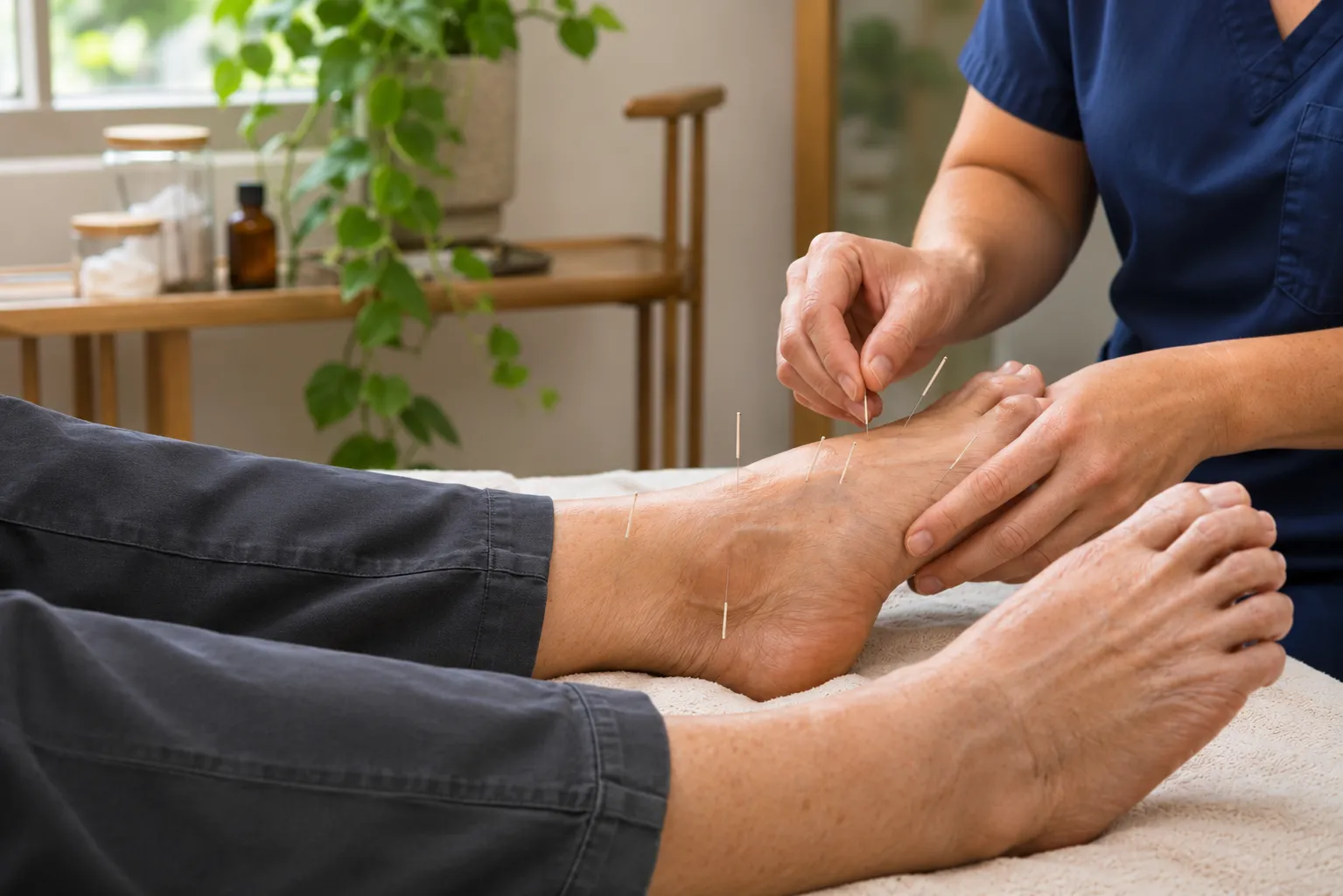
No two myofascial injuries are the same, and no single tool fixes one. Some patients need hands-on work early, some need more loading, some do well with tape or shockwave, and some never need them. Some patients also choose to add acupuncture or cupping with Dr. Heather Schuerlein, AP, DACM, Dipl.AcCHM, FABORM, alongside their chiropractic care. The exam and your goals decide what’s in your plan, not the equipment we happen to have.
When to see a physician or go to the ER instead
Most muscle injuries are minor, but some need a physician, imaging or emergency care. Get checked by a physician right away, or go to the ER, if you have:
- A pop you heard or felt at the moment of injury, or a visible dent or gap in the muscle (a possible complete tear)
- Inability to move the muscle, put weight on the leg or use the limb
- Severe pain, swelling or bruising, or swelling that keeps getting worse
- Numbness, tingling or sudden weakness
- Calf pain with swelling, warmth or redness, especially after travel, surgery or a long period of sitting, which can signal a blood clot
- Back pain with new bladder or bowel changes, numbness in the groin or inner thighs, or rapidly worsening leg weakness
- Chest pain, shortness of breath or arm pain that isn’t clearly from a strain
If we find signs during an exam that something more serious is going on, we refer you to a physician, for imaging or to the ER. Chiropractic care supports healing. It doesn’t replace medical care.
Frequently asked questions
How long does a pulled muscle take to heal?
It depends on how badly it’s injured. A mild Grade I strain usually heals within a few weeks. A Grade II partial tear can take several weeks to months. A complete Grade III tear may need surgery and four to six months or more of recovery. Even after pain is gone, the tissue keeps remodeling for months, which is why a gradual return to activity matters.
Should I use ice or heat on a pulled muscle?
Ice can help with pain in the first few days, but there’s little high-quality evidence that it speeds healing. Gentle movement, relative rest for a day or three, elevation and compression matter more early on. Heat is usually more comfortable later, when the area feels stiff rather than swollen. If you’re unsure, ask us at your exam.
What is a trigger point?
A trigger point is a small, tender knot in a muscle. Pressing it hurts on the spot and can also send pain a short distance away, which is called referred pain. Trigger points often show up after an injury, with repetitive motion or poor posture, or after a long period of inactivity. They tend to respond best when treated early.
What is cupping, and what are the marks?
Cupping uses glass, silicone or plastic cups to create suction on the skin, lifting the skin and the tissue underneath. The round marks it leaves come from that suction and are temporary. Research on cupping for pain suggests it may help, so we use it as one piece of a plan, not the whole plan. Dr. Bryan and Dr. Heather both offer cupping. Let your other providers know about the marks so they aren’t mistaken for an injury.
What is Graston or IASTM?
IASTM stands for instrument-assisted soft tissue mobilization. Graston is one well-known brand of it. A provider uses smooth stainless steel tools to work along muscle and fascia, find restricted areas and help restore movement. I co-wrote New York Chiropractic College’s IASTM manual and helped develop the ConnecTX tool with Dr. Hunter Mollin, and IASTM is what finally resolved my own frozen shoulder as a student.
Does kinesiology taping help?
It can help a bit. A systematic review found kinesiotape relieved pain better than minimal or no treatment, but it didn’t outperform other active treatments for longer-lasting pain. We use it as a support tool for comfort, posture and swelling alongside hands-on care and exercise, not on its own.
Do chiropractors do soft tissue or massage work?
Many do, and in our office it’s a big part of care. I use IASTM, manual therapy, trigger point work and muscle energy stretching, and our clinic also has a licensed massage therapist. Soft tissue work is often what a myofascial injury needs most, alongside a plan to load the tissue back to full strength.
When can I get back to my sport after a muscle strain?
When the injured area has its strength, range of motion and control back, not just when the pain is gone. That usually means working through progressive strength and sport-specific drills first. Returning too early, during the repair or early remodeling phase, is one of the biggest reasons strains come back.
Ready to get back to what you love?
Whether it’s a fresh strain or a knot that has hung around for months, we’ll start with a full exam and build a plan around your injury and your goals. Palm Coast Acupuncture & Chiropractic, 4875 Palm Coast Pkwy NW, Units 2 & 3, Palm Coast, FL 32137.
Dr. Bryan Schuerlein, DC | Sports Chiropractor | Palm Coast Acupuncture & Chiropractic, Palm Coast, FL
Sources
- Soft-tissue injuries simply need PEACE and LOVE, British Journal of Sports Medicine, 2020
- Soft Tissue Repair and Tissue Healing Review, Tim Watson, Electrotherapy.org
- Soft Tissue Healing, Physiopedia
- Muscle Strains, Cleveland Clinic
- Myofascial Pain Syndrome, Cleveland Clinic
- Cupping, National Center for Complementary and Integrative Health
- The efficacy of instrument assisted soft tissue mobilization: a systematic review, Journal of the Canadian Chiropractic Association, 2016
- Kinesio taping in musculoskeletal pain and disability that lasts for more than 4 weeks, British Journal of Sports Medicine, 2015