By Bryan Schuerlein, DC · Palm Coast Acupuncture & Chiropractic · Published: November 2026
Key Findings at a Glance
- Condition: Persistent neck and low back pain after a rear-impact collision; MRI showed C4-5 and C6-7 disc herniations with annular fissures and an L4-5 herniation with small extrusion
- History: About 8 months of chiropractic care at another office without symptom resolution before presenting here
- Treatment: 13 visits over about 3 months (roughly weekly), lumbar and pelvic adjusting, soft tissue work and a graduated home exercise program; the patient declined cervical manipulation
- Outcome: Neck and low back pain 4/10 to 0/10; Neck Disability Index 16/100 to 0/100; Revised Oswestry 14/100 to 0/100
- Adverse events: None reported
Abstract
This report describes conservative chiropractic management of a 45-year-old man with neck and low back pain following a rear-impact motor vehicle collision. He presented after about 8 months of chiropractic care at another office without symptom resolution. MRI performed about four weeks after the collision showed craniocervical ligament edema, which the radiologist described as most consistent with craniocervical ligament sprain and whiplash-type injury, along with multilevel cervical disc herniations with annular fissuring and an L4-5 disc herniation with small extrusion. At his request, no cervical manipulation was performed. Over 13 visits across about 3 months, pain fell from 4/10 to 0/10 in both regions, and Neck Disability Index and Revised Oswestry scores fell from 16/100 and 14/100 to 0/100. As a single case without a control, this report cannot establish that treatment caused the improvement, but symptom resolution after a long period of persistent pain is clinically notable.
Consent
The patient gave written informed consent for publication of this de-identified case report.
Timeline
- Collision: Restrained driver, vehicle stopped, struck from behind. No airbag deployment, no loss of consciousness.
- About 4 weeks after: Cervical and lumbar MRI.
- Following 8 months: Chiropractic care at another office; symptoms did not resolve. Prior treatment records were not available for review.
- About 9 months after: Initial evaluation at our clinic.
- Next ~3 months: 13 visits, then discharge.
Case Presentation
Neck. Left-sided neck pain rated 4/10, present about 75% of waking hours, beginning at the time of the collision. Described as sharp, dull and stiff, and aggravated by extension and right rotation. The patient reported no neck pain before the collision. About a month before evaluation, a period of prolonged static neck rotation triggered a locking sensation with pain up to 8/10 on extension.
Low back. Low back pain rated 4/10, present about 50% of waking hours, sharp and throbbing, aggravated by forward bending, rotation, driving, rising from sitting and sneezing. The patient reported no low back pain before the collision.
Function at intake. Neck Disability Index 16/100 and Revised Oswestry 14/100, both in the mild disability range. Prolonged sitting, computer work and repetitive lifting were affected.
Examination
- Segmental restriction at L4, L5 and the left ilium
- Hypertonicity of the left sternocleidomastoid, bilateral erector spinae and bilateral piriformis
- Positive: foraminal compression (left neck pain), Kemp's test (left lumbar), piriformis test, Nachlas' test (bilateral), Yeoman's test (left sacroiliac)
- Negative: straight leg raise and Minor's sign, bilaterally
- No cervical radicular or disc symptoms were present at presentation. Because the patient declined cervical manipulation, a formal cervical neurologic exam was not recorded.
Kemp's test and the L4-5 restriction point to lumbar facet and disc involvement. Yeoman's test and the left ilium restriction point to separate sacroiliac involvement.
Imaging (about 4 weeks after the collision)
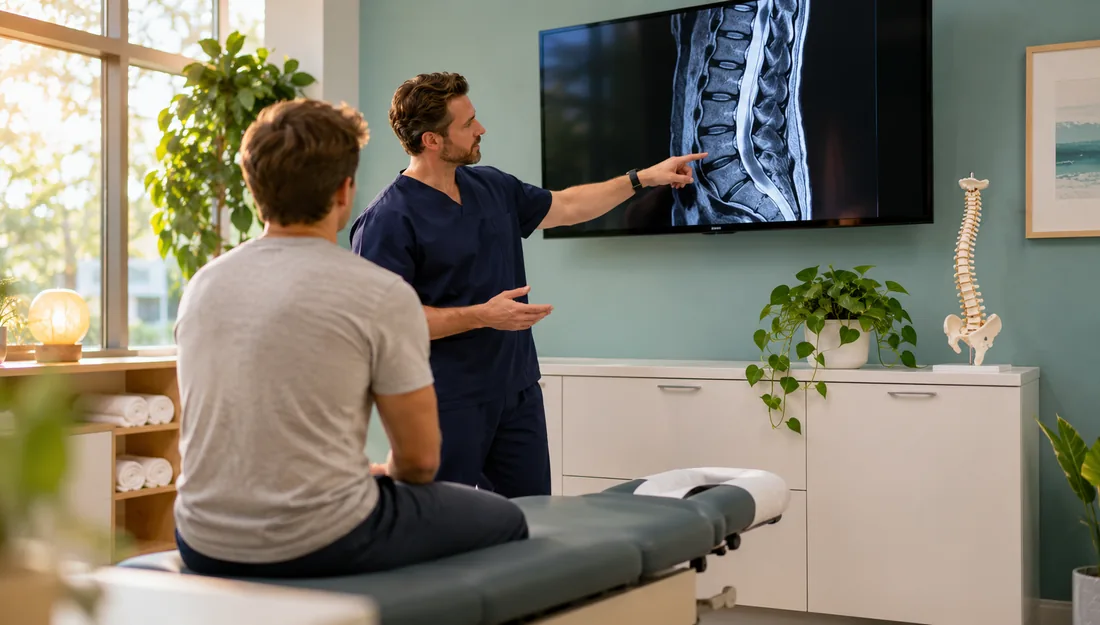
Cervical MRI: Straightened cervical lordosis. Apical and bilateral alar ligament edema; radiologist's impression of craniocervical ligament sprain and whiplash-type injury. C4-5 posterior central herniation with annular fissure, reduced disc height, canal stenosis and bilateral foraminal narrowing with nerve root impingement. C5-6 posterior bulge contacting the thecal sac. C6-7 posterior central herniation with 2 mm superior extrusion, annular fissure, reduced disc height, canal stenosis and bilateral foraminal narrowing with nerve root impingement.
Lumbar MRI: Reduced lumbar lordosis. L3-4 posterior bulge. L4-5 posterior central herniation with 1 mm inferior extrusion, annular fissure, reduced disc height, moderate canal stenosis and moderate bilateral foraminal narrowing with nerve root impingement. The radiologist noted that annular fissures can represent annular rupture and edema related to acute or subacute injury.
Interpretation. The ligament edema and annular findings are consistent with the reported mechanism, and the L4-5 findings match the segments found restricted on exam. Reduced disc height and stenosis at age 45 may partly predate the collision, and alar ligament signal changes are also seen in some people without injury. This imaging reflects his status about four weeks after the collision, not at presentation here, and no follow-up imaging was performed.
Treatment
The patient asked that his neck not be adjusted, so cervical care used soft tissue work and modalities only.
| Phase | Visits | Interventions |
|---|---|---|
| 1. Pain and spasm control | 1–4 | Diversified and Thompson adjusting to L4, L5 and left ilium; electrical stimulation to cervical muscles; heat; lumbar mobility exercise |
| 2. Soft tissue | 5–7 | Myofascial release to left SCM, bilateral erector spinae, piriformis and psoas; continued lumbar and pelvic adjusting |
| 3. Functional stabilization | 8–13 | Continued adjusting; graduated motor control program (bird dog, dead bug, McKenzie extensions, 3 sets of 5) |
Pain plateaued at 2/10 in both regions from visits 6 to 11, with flares tied to activity such as getting in and out of a vehicle. Home exercise compliance and range of motion continued to improve, and pain reached 0/10 after the move to active stabilization work. No adverse reactions were reported.
Outcomes at Discharge
| Measure | Intake | Discharge |
|---|---|---|
| Neck pain (NRS) | 4/10, 75% of waking hours | 0/10 |
| Low back pain (NRS) | 4/10, 50% of waking hours | 0/10 |
| Neck Disability Index | 16/100 | 0/100 |
| Revised Oswestry | 14/100 | 0/100 |
Kemp's and piriformis tests remained positive at discharge, and the left piriformis remained hypertonic, so some joint and muscle dysfunction persisted despite the absence of pain. The patient reported a return to bending, lifting, twisting and all pre-collision daily activities. He was discharged early with the option to return for re-evaluation as needed.
Limitations
- A single case without a control group cannot show that treatment caused the improvement.
- Records of the prior 8 months of care were not available, so its content is unknown.
- Baseline disability was mild (NDI 16, Oswestry 14).
- Some imaging findings may predate the collision, and no follow-up imaging was done.
- No follow-up after discharge is reported.
- A formal cervical neurologic examination was not recorded.
Clinical Takeaways
- Persistent pain can still respond. This patient's symptoms had not resolved after 8 months of care, yet resolved over 13 visits with an individualized plan.
- Treatment can respect patient preference. Neck pain resolved without cervical manipulation, using soft tissue work and lumbar and pelvic care.
- Active care matters. The last step from 2/10 to 0/10 came with the shift to motor control exercise.
- Record what remains. Documenting positive findings at discharge gives a more honest picture than declaring a cure.
Frequently Asked Questions
Can a rear-end collision cause disc herniations?
It can contribute. In this case, MRI four weeks after the collision showed herniations with annular fissures that the radiologist said can reflect acute or subacute injury. Disc changes are also common without trauma, so imaging alone can't always show cause.
How long does chiropractic care take for neck and back pain after a car accident?
It varies. This patient needed 13 visits over about 3 months after earlier care had not resolved his symptoms. Severity, duration and home exercise all affect the timeline.
Is surgery always needed for disc herniations after an accident?
No. Many people improve with conservative care, as this patient did. Surgical consultation is appropriate with progressive weakness, numbness, loss of bladder or bowel control, or other red flags.
How is recovery measured?
With validated questionnaires such as the Neck Disability Index and Revised Oswestry, alongside 0 to 10 pain ratings at each re-evaluation.
Does car insurance (PIP) cover a chiropractor after an accident in Florida?
Usually, yes. Florida PIP generally pays 80% of reasonable medical costs up to $10,000, including chiropractic care, as long as you get care within 14 days of the crash. Without an emergency medical condition diagnosis, benefits are capped at $2,500. Bring your claim number and insurer details to your first visit, and we’ll check your coverage before treatment starts.
Can a chiropractor help neck pain?
Often, yes, and adjusting the neck isn’t the only option. In this case the patient asked us not to manipulate his neck. His neck pain still went from 4/10 to 0/10 with care focused on his lower back, pelvis and soft tissue. Neck pain with arm numbness, weakness or a recent injury should be examined before any treatment.
How many visits until I feel better?
It depends on the condition and how long you’ve had it. Many people notice change within the first few visits. This patient had 8 months of symptoms and reached zero pain in 13 visits over about 3 months. We recheck progress with standard outcome scores and adjust the plan or discharge when goals are met.
Medical disclaimer: This case report describes one patient's outcome and does not guarantee similar results. Care is individualized based on examination and imaging.